I keep a battered index card taped inside my closet door, right next to the hiking boots. Six years ago I couldn't have told you the difference between "mobility" and "flexibility" if you'd handed me a dictionary — now I split my mornings between the two like they're separate chores, because mixing them up is exactly how I spent an entire winter stretching for nothing while my hips still seized up on the first spring hike up the Blue Hills. This is the cheat sheet I built for myself: what each move actually targets, so you're not doing pigeon pose for your hamstrings when it's your hip capsule that's stuck.
Core Definitions: Mobility vs. Flexibility
Here's the distinction that took me embarrassingly long to get straight. Flexibility is what your muscles can do passively — how far something lengthens when you're not actively fighting it, like leaning into a hamstring stretch and just waiting it out. Mobility is what your joint can do actively, under your own power — the thing that actually gets you up a rocky switchback without your knee locking halfway through (Hinge Health lays out the same split). You can be flexible as a pretzel on a yoga mat and still move like a rusted gate on the trail if the mobility side never got trained. Learned that one the hard way.
- Flexibility (passive): how far a muscle lengthens when you're not actively working — think leaning into a hamstring stretch and waiting it out.
- Mobility (active): how far a joint moves under your own power — the control that gets you up a rocky switchback without the knee locking.
The distinction that changes everything: flexibility is passive reach; mobility is active, powered control. You can be flexible as a pretzel on a yoga mat and still move like a rusted gate on the trail if the mobility side never got trained — which is why the moves below are grouped by the joint they train, not by how far they let you bend.
Glossary of Mobility and Flexibility Exercises
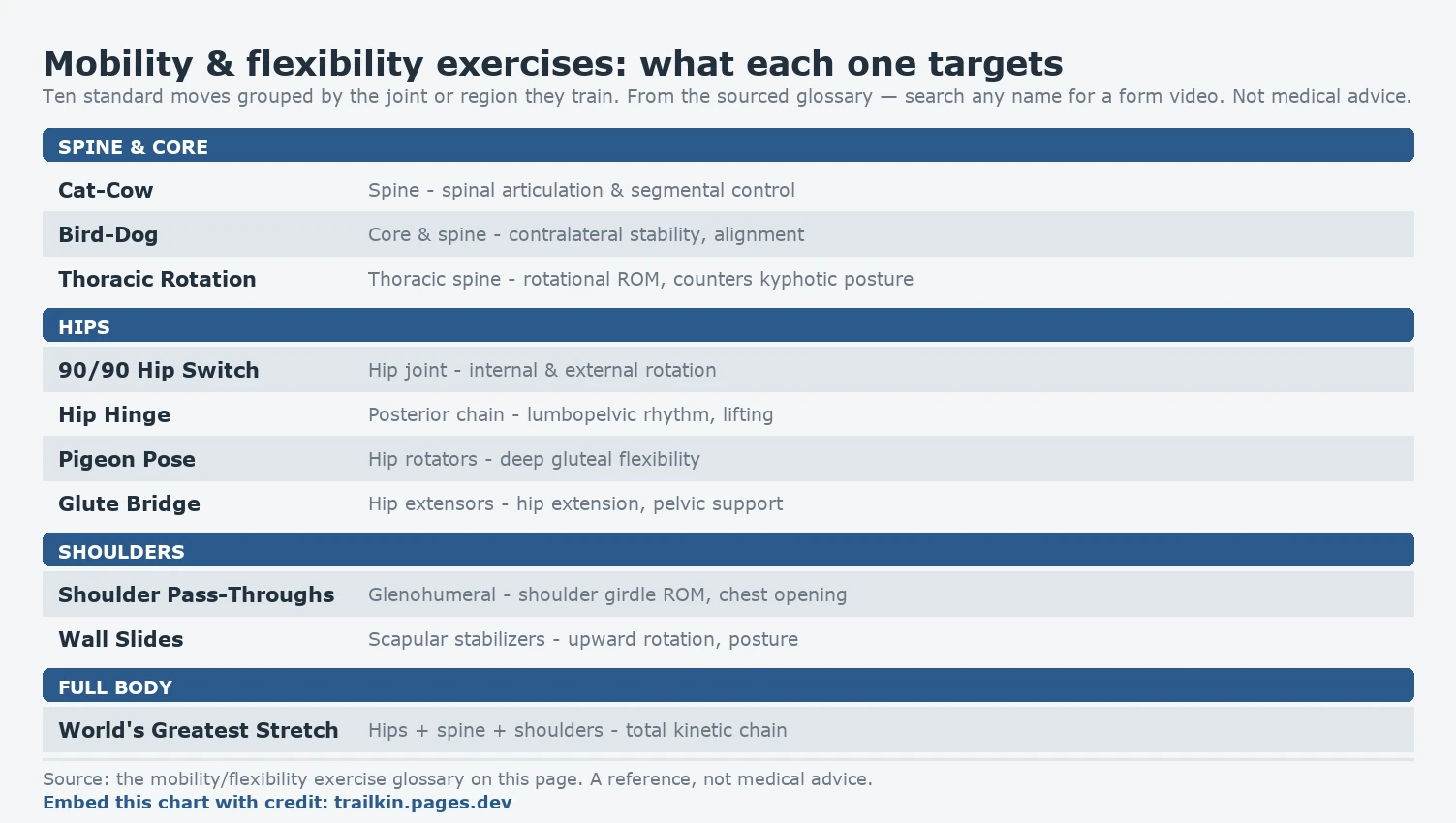
These are the standard names — the ones a physical therapist or a decent YouTube trainer will use, so you can search any one of them and pull up form videos. I do the 90/90 Hip Switch on the living room rug most nights, the same seated 90-degree position Cleveland Clinic walks through (Cleveland Clinic's rundown) — hardly glamorous, but my hips don't care about glamour.
| Exercise Name | Primary Target (Joint/Muscle) | Functional Objective | Description of Movement |
|---|---|---|---|
| Cat-Cow | Spine (Cervical, Thoracic, Lumbar) | Spinal articulation and segmental control. | A quadruped movement alternating between spinal flexion (arching) and extension (dipping). |
| Bird-Dog | Core, Erector Spinae, Gluteus Maximus | Contralateral stability and spinal alignment. | Simultaneous extension of the opposite arm and leg from a quadruped position. |
| Thoracic Rotation | Thoracic Spine (T1-T12) | Rotational ROM; counteracts kyphotic posture. | Rotating the upper trunk while the lumbar spine remains stabilized, often performed in a side-lying or quadruped position. |
| 90/90 Hip Switch | Hip Joint (Acetabulofemoral) | Internal and external hip rotation. | Seated movement where legs are bent at 90-degree angles and rotated from side to side to address joint capsule tightness. |
| Shoulder Pass-Throughs | Glenohumeral Joint / Scapulothoracic Joint | Shoulder girdle ROM and chest opening. | Moving a dowel or band from the front of the hips to the lower back with straight arms. |
| Wall Slides | Scapular Stabilizers / Lower Trapezius | Scapular upward rotation and postural correction. | Pressing arms and back against a wall while sliding the elbows and hands upward in a "Y" shape. |
| Hip Hinge | Posterior Chain (Hamstrings/Glutes) | Lumbopelvic rhythm and lifting mechanics. | Bending at the hips with a neutral spine, shifting the center of mass backward without significant knee flexion. |
| Pigeon Pose | Hip Rotators (Piriformis) / Hip Flexors | Deep gluteal flexibility. | A floor-based stretch where one leg is folded in front of the body at a 45- to 90-degree angle while the other extends behind. |
| Glute Bridge | Hip Extensors / Lumbar Stabilizers | Hip extension and pelvic floor support. | Lying supine and lifting the pelvis toward the ceiling by contracting the gluteal muscles. |
| World's Greatest Stretch | Multi-joint (Hips, Spine, Shoulders) | Total body kinetic chain integration. | A complex movement involving a deep lunge, elbow-to-instep reach, and thoracic rotation. |
Anatomical Benchmarks for Adults 50+
Here's where I get honest about what's actually changing in a body my age. It's not nothing.
- Spinal Flexibility Decline
- A review of the spinal range-of-motion research puts it at roughly a 30% drop in available lumbar motion between your twenties and age 70 (spinal ROM review). That tracks — weeding the garden bed used to be nothing, and now it's a deliberate hip-hinge instead of just bending, the same way trail planning stopped being "pick a loop" and became "check the elevation profile first."
- Ankle Dorsiflexion
- You need at least 15° of it for a normal walking stride (clinical ROM reference). Lose that and every downhill stretch turns into tiny, cautious baby steps — which is exactly what started happening to my neighbor Carol before she added ankle circles to her own morning routine.
- Mobility Prevalence
- About 12.2% of U.S. adults deal with a mobility disability serious enough to make walking or climbing stairs hard (CDC data) — a number I think about every time I watch someone white-knuckle the railing at a trailhead parking lot. I'm not there yet. I fully intend to keep it that way, which is the entire reason this page exists.
One more honest thing, since I promised myself I'd always mention what didn't work: I spent real money on one of those vibrating foam rollers a few years back, convinced it would loosen my hips faster than plain old movement. It buzzed. My hips stayed exactly as stuck as before. Turns out there's no shortcut around actually doing the reps.
Quick reality check, because this is a body we're talking about, not a spreadsheet: I'm not a doctor, a physical therapist, or a trainer — just a hiker who got tired of guessing. Everything above comes from what I've read and tested on my own joints, not a medical degree, so treat it as a starting point and not a prescription. If you've got osteoporosis, a recent hip or knee replacement, or any diagnosed spine condition, talk to your doctor or a physical therapist before working deep spinal-flexion moves like Cat-Cow or the World's Greatest Stretch into your routine — forward bending under load is one of the first things PTs restrict with osteoporosis, and your vertebrae aren't the place to find out the hard way. Every body ages differently. Mine clearly has opinions about hiking boots; yours might have opinions about something else entirely.
Last verified: 2026-07-11