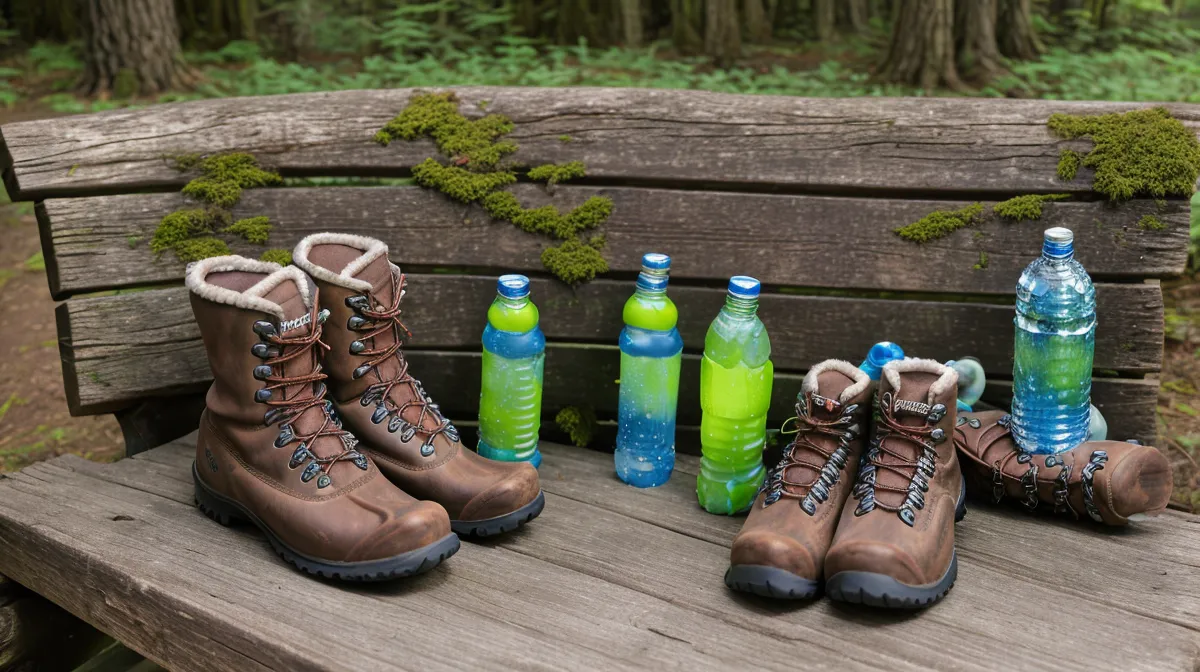
Dried mud on my boots, from a trail I never finished. Noanet Woodlands — a loop I used to walk without thinking twice. Hiking every weekend was simply who I was for most of my life. Now active aging, joint health, the whole business of hiking after 50 have turned my favorite Saturday habit into a quiet negotiation with my own hips and knees.
Quick heads-up before we go further: there are affiliate links in here. Buy through one and I earn a small commission, at no extra cost to you. I only point at gear and routines I have actually used, on real trails and in my own kitchen, so nothing here is a guess. My full disclosure lives on the site.
Two Ways to Keep Hiking After 50
Look, once your joints start filing complaints, you really get two honest choices, and pretending there is a third one just wastes a good year of being angry about it.
One choice is to keep the miles and white-knuckle through them. Push the long rocky loops, ice everything afterward, and treat your body like it owes you the legs you had at forty. That was my plan for longer than I would like to admit.
The other choice is to trade some of that distance for staying power. Shorter trails. Better-cushioned boots. Trekking poles that take a share of the load off the knees on the steep parts — which is a whole subject of its own. A little daily joint support. Less heroics, more Saturdays.

The Push-Through Plan Quietly Backfired
For a long stretch I leaned hard on an ice pack routine — bags of frozen peas on both knees after every hike, propped up on the couch like that would buy back the miles. It numbed things for an evening. It changed nothing about the next morning. That is the trouble with the push-through plan: it treats the sore spot and ignores the math. It is supply and demand, really — I kept piling on miles while quietly cutting back on everything that helps a joint absorb them, including the synovial fluid that keeps the parts gliding. Repetitive pounding with no support underneath does not make a joint tougher. Sometimes it just wears it down faster.
Here is the thing — I won't pretend I don't miss the old way. A long loop used to leave me pleasantly tired, the good kind of wrecked, not limping for three days. And a desk job does not help; a week hunched over spreadsheets stiffens my hips before I even reach a trailhead, which is why I run through Best Exercises for Stiff Knees After Sitting at a Desk All Day on those weeks just to undo a little of the damage. Letting the long miles go felt like a defeat at first. It took me a while to read it as a trade instead.
Fluid or Strength: Finding Your Saturday Support
Joint support is where the comparison gets practical, and a few different approaches sit on the card table beside my desk, half-tested. Joint Genesis is the one I reach for daily — it is a single capsule, easy to fold into a morning, and it leans on the lubrication side of things, the fluid that tends to dry up as we get older. It is friendly for most diets too — no shellfish, no gluten, no dairy. The honest catch: it is not cheap, you have to order it online, and it builds slowly, so you need patience before you judge it. The long version of how that went for me is in My Honest Review of Joint Genesis After Three Months.
Two other routes sit beside it, and they fit different people. Ageless Knees is not a pill at all — it is a home exercise program built to strengthen the muscles around the knee. Cheap to try, no bottle to reorder, and it pairs fine with anything else. The trade-off: it only looks after the knees, not the hips or shoulders, and it is digital-only, so you have to actually do the work yourself. JointVive vs Standard Glucosamine: What Worked for Me walks the more familiar road — glucosamine and chondroitin, the classic combo, with a little something extra folded in for active days. People have sworn by that route for years or shrugged at it, depending who you ask. It asks for more than one capsule a day, and it contains shellfish, so the allergy crowd has to sit it out.
Weighing Miles Against Mobility
My rule is almost boring, which is probably why it sticks. Before I pick a trail, I check three things — how my hips feel climbing out of the car, what the next morning asks of my legs, and how rough the descent runs. If a desk week has stiffened me up, or the descent is all granite steps and I have somewhere to be on Sunday, that is a short-loop day, no debate. Smooth path, open Sunday, hips that already feel loose? Then I will earn the longer miles. The daily Joint Genesis capsule is the quiet anchor under all of it — the part I do not have to think about.
Most of this gets sorted at a corner desk in the back bedroom of our Natick raised ranch, where the north window stares straight at the neighbor's stockade fence and that card table stays buried under trail shoes I am breaking in. Even a good boot's cushioning flattens out after enough miles, so I rotate mine sooner than I used to. A couple of resistance bands live in a basket by the door — most evenings I loop one over the door handle and feel it give and snap back while I work a slow stretch, which does more for my hips than I ever expected. My neighbor Jim Pollard, two doors down and a reluctant trail walker at best, still checks trail conditions on some website that looks frozen in 2009 before he will commit to a single loop. We go anyway.
Pick the Trail That Lets You Hike Again Tomorrow
These days I can crouch down, tie both boots, and stand back up in one motion — no hand on the bench, no little grunt on the way up. That is the whole payoff, right there. So here is how I would call it for anyone standing in their own mudroom: take the long miles when the trail is forgiving, your joints feel loose, and nothing the next morning leans on your legs. Choose the shorter loop with real support — better boots, poles, a daily capsule — when the descents bite, when a desk week has tightened you up, or when you simply want to be back out there tomorrow instead of icing on the couch. A reader named Elaine Brosnan writes in from western Massachusetts now and then; she leans on water aerobics between hikes and stays refreshingly honest about what it does and does not do for her trail legs. Different tools, same idea — adapt the plan so the plan never has to end.
We are not quitting — let me be clear about that. Trading miles for mobility is not waving a white flag; it is a tactical retreat so you stay in the game. I am not a doctor, just a woman who refuses to let stiffness win, so run any real change past a professional first. If the dry, grinding feeling in your joints is starting to shorten your Saturdays and you want to test the lubrication angle for yourself, you might check out Joint Genesis for yourself — it comes with a long enough money-back window to try it across a full season of hiking. See you out there. I will be the one on the short loop, poles clicking, grinning like the trees look just as good from there. Because they do.