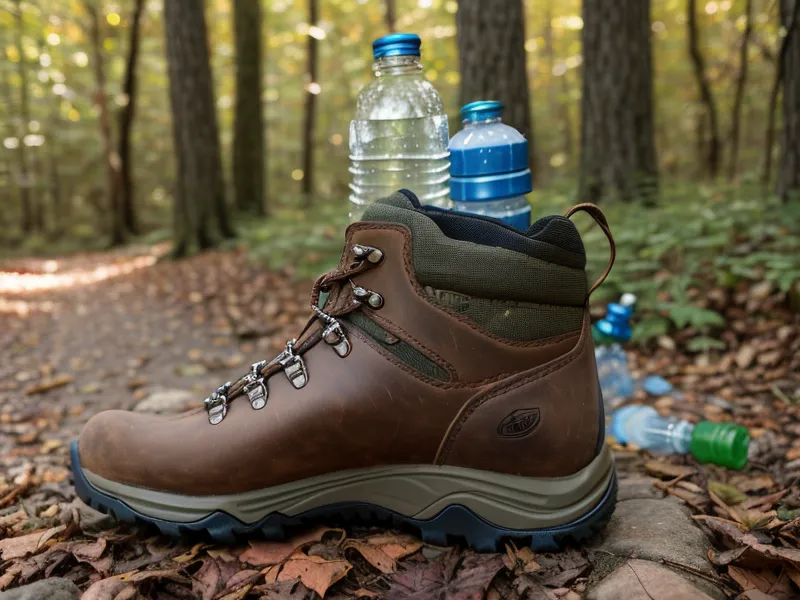
The bottle of ibuprofen in my glovebox is still sealed. My hand went to it out of plain habit after a long climb on the Skyline Trail — then I caught myself, because I hadn't needed it once on the drive home.
That small thing reset how I think about joint health and hiking after 50. For years I treated my knees as a trail problem. Turns out the trail was never really the issue.
Quick disclosure before I go further — a couple of the links below are affiliate links, which means I earn a small commission if you buy through them, at no extra cost to you. I only point at things I've actually used or dug into seriously.
Between the hikes is where it actually breaks
Here's the thing about a weekend hike — the hard part isn't the hike. It's the five days before it.
All the trail stuff was handled. Wider boots. Poles. Shorter loops so I wasn't staring down eight miles anymore. Every fix I made pointed straight at Saturday, like a laser. And my knees still went tight in that first slow climb, every single time.
The pattern I'd been missing had nothing to do with the trail. One ordinary weekday, standing in line for the office microwave, my legs gone to concrete after a morning of back-to-back calls, it lined up for me — my joints had barely moved since I sat down, and two days later I'd ask them to haul me up a hill and act surprised when they balked.
Think about trail planning for a second. You don't plan the route standing at the trailhead — you sort it out the week before, at the kitchen table. Joints work a little like that. What you do Monday through Friday shows up on Saturday. Mine simply do better when the week has movement scattered through it. That's the whole pattern, and it's almost annoying how plain it is. I wrote up the small weekday moves that helped me over at exercises for stiff knees after sitting at a desk.
The orthotics that did nothing
Before any of that sank in, I spent real money on custom orthotics. Molded to my feet, the full treatment. I was sure the problem was support — that if my stride got propped up correctly, my knees would quit complaining.
They did nothing for the stiffness. Nothing. Maybe they were fine arch support, but I'd aimed them at the wrong target — a trail-day fix for a problem that lived in my desk chair. That was the mistake I kept making in different costumes: chasing the moment of pain instead of the quiet days that built up to it.
Maureen Callahan — my Saturday hiking partner for more years than I can count — keeps a beat-up little paper journal where she logs our pace on every loop. She flipped it open one morning and pointed out we'd been finishing quicker, and that I'd stopped grinding to a halt to "fix a sock" every quarter mile. That was the first outside proof I wasn't imagining the change.
JointVive and weekend lubrication
Short answer: not the way the question usually means it. You can't dose your way to a smooth Saturday with one supplement swallowed the night before. At least I never could. Treat JointVive as a weekend lubricant and you're right back to fixing the wrong moment.
What worked for me was treating it as a weekday habit instead. JointVive is the classic formula — glucosamine and chondroitin, with a little turmeric added. I take it on the ordinary Tuesdays, not just before a hike, as one piece of a Monday-through-Friday focus on actually moving more during the day. Did the supplement do the work, or did the movement? I honestly can't separate the two, and I won't pretend I can. The combination is what made that first hour on the trail stop feeling like cold hinges.
It wasn't fast, either. The first hour didn't really ease up until I'd strung together about seven weeks of steadier weekdays — no single dramatic morning, just a slow loosening I almost talked myself out of noticing.
One honest caution before you try it. It's a few capsules a day, which is easy to forget on a scrambled morning. And if you have a shellfish allergy, read the label carefully, because this kind of formula often isn't an option for you. If you want the longer side-by-side, here's JointVive vs. standard glucosamine.
Glucosamine · Chondroitin · Turmeric · Classic joint support formula
Check Current Price →
On mornings when several capsules just aren't happening, I reach for Joint Genesis instead — a simpler one-capsule option that's easier to keep up when the day is already chaos. I put down my honest three-month take on Joint Genesis if that angle interests you. And if pills aren't your thing at all, Ageless Knees is a movement-based program built on the same idea — strengthen the muscles around the joint rather than supplement it from the inside.
What to check before you reach for a bottle
Here's the one thing I'd actually check first, before spending a dime on any of this. Look at your week, not your weekend. Is your stiffness worst in the first hour of a hike, right after a still few days? Then the real lever is Monday through Friday — small bursts of mobility spread across the workweek — far more than anything you swallow at the trailhead.
Kathleen Sobieski, a fellow hiker from my Wednesday-night walking group, keeps a tidy log of how her range of motion shifts week to week. She'll tell you the same thing straight from her own notes — the good trail mornings track the active weeks, not the supplement bottle on its own. A bottle can be one helpful piece. It is not the whole answer, and anyone selling it as a weekend cure is skipping the boring part that actually matters.
The foam roller and a couple of resistance bands live in a basket by the door of the back-bedroom corner where my half-tested trail shoes sit on a card table. Not because the gear is magic — but because keeping it underfoot is the only way I remember to use it on a Wednesday.
Still somewhere in the middle
My hikes are better than they used to be. The first hour isn't the grind it once was, and that glovebox bottle keeps quietly not getting opened. I think the weekday approach is doing something real, though I can't tell you which slice of it deserves the credit, and I'm not going to invent an answer to sound tidier.
Bad Saturdays still happen. Weeks where I barely move and pay for it on the climb still happen too. I haven't beaten this — I've learned to manage it on purpose, which is a smaller and far truer thing to claim.
If there's one thing worth carrying out of all this, it's the reframe — stop trying to rescue the hike at the trailhead. Tend the quiet weekdays in between, and let Saturday be the reward instead of the repair. I'm not a doctor, and this is just what's worked for one stubborn hiker who refused to trade the trail for the couch.